Ebook Download A Sand County Almanac, by Aldo Leopold
Reviewing A Sand County Almanac, By Aldo Leopold is a very valuable interest and also doing that can be undertaken at any time. It suggests that checking out a book will certainly not restrict your activity, will not force the moment to invest over, and won't invest much money. It is a very budget-friendly and also reachable thing to purchase A Sand County Almanac, By Aldo Leopold But, keeping that really affordable thing, you could get something new, A Sand County Almanac, By Aldo Leopold something that you never ever do and also get in your life.
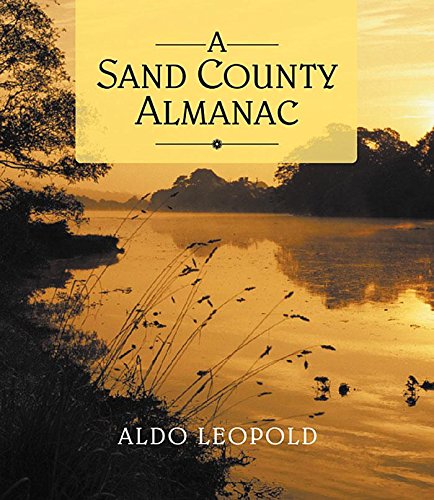
A Sand County Almanac, by Aldo Leopold

Ebook Download A Sand County Almanac, by Aldo Leopold
Find out the technique of doing something from many resources. Among them is this book qualify A Sand County Almanac, By Aldo Leopold It is an extremely well recognized book A Sand County Almanac, By Aldo Leopold that can be recommendation to review currently. This suggested publication is one of the all excellent A Sand County Almanac, By Aldo Leopold collections that remain in this website. You will certainly additionally find other title and also styles from different authors to search right here.
If you get the printed book A Sand County Almanac, By Aldo Leopold in on-line book establishment, you may additionally find the very same issue. So, you must move shop to establishment A Sand County Almanac, By Aldo Leopold and also look for the offered there. However, it will not take place right here. Guide A Sand County Almanac, By Aldo Leopold that we will provide right here is the soft file idea. This is what make you can easily locate and get this A Sand County Almanac, By Aldo Leopold by reading this site. We provide you A Sand County Almanac, By Aldo Leopold the best item, always and always.
Never ever question with our deal, because we will certainly always give what you need. As similar to this upgraded book A Sand County Almanac, By Aldo Leopold, you may not discover in the other place. Yet below, it's very simple. Simply click and also download and install, you can possess the A Sand County Almanac, By Aldo Leopold When simplicity will reduce your life, why should take the challenging one? You could purchase the soft documents of guide A Sand County Almanac, By Aldo Leopold here and be participant of us. Besides this book A Sand County Almanac, By Aldo Leopold, you can additionally discover hundreds listings of the books from many resources, compilations, authors, and writers in all over the world.
By clicking the link that we offer, you can take guide A Sand County Almanac, By Aldo Leopold completely. Link to web, download, and conserve to your gadget. Just what else to ask? Reading can be so very easy when you have the soft data of this A Sand County Almanac, By Aldo Leopold in your gizmo. You could also duplicate the data A Sand County Almanac, By Aldo Leopold to your workplace computer system or in your home as well as in your laptop computer. Merely discuss this excellent news to others. Recommend them to see this web page as well as obtain their looked for publications A Sand County Almanac, By Aldo Leopold.
First published in 1949 and praised in The New York Times Book Review as "a trenchant book, full of vigor and bite," A SAND COUNTY ALMANAC combines some of the finest nature writing since Thoreau with an outspoken and highly ethical regard for America's relationship to the land. As the forerunner to such important books as Annie Dillard's Pilgrim at Tinker Creek, Edward Abbey's Desert Solitaire, and Robert Finch's The Primal Place, this classic work remains as relevant today as it was nearly sixty years ago.
- Sales Rank: #1044980 in Books
- Published on: 2006-08-07
- Released on: 2006-08-07
- Formats: Abridged, Audiobook, CD
- Original language: English
- Number of items: 3
- Dimensions: 5.30" h x 14.22" w x 6.40" l, .26 pounds
- Running time: 2 Hours
- Binding: Audio CD
Amazon.com Review
Published in 1949, shortly after the author's death, A Sand County Almanac is a classic of nature writing, widely cited as one of the most influential nature books ever published. Writing from the vantage of his summer shack along the banks of the Wisconsin River, Leopold mixes essay, polemic, and memoir in his book's pages. In one famous episode, he writes of killing a female wolf early in his career as a forest ranger, coming upon his victim just as she was dying, "in time to watch a fierce green fire dying in her eyes.... I was young then, and full of trigger-itch; I thought that because fewer wolves meant more deer, no wolves would mean hunters' paradise. But after seeing the green fire die, I sensed that neither the wolf nor the mountain agreed with such a view." Leopold's road-to-Damascus change of view would find its fruit some years later in his so-called land ethic, in which he held that nothing that disturbs the balance of nature is right. Much of Almanac elaborates on this basic premise, as well as on Leopold's view that it is something of a human duty to preserve as much wild land as possible, as a kind of bank for the biological future of all species. Beautifully written, quiet, and elegant, Leopold's book deserves continued study and discussion today. --Gregory McNamee
From Publishers Weekly
These original essays on the natural environment by renowned conservationist Leopold (1887-1948) were first published posthumously in 1949. In this edition, more than 80 lush photographs shot by nature photographer Sewell on Leopold's former Wisconsin farm accompany the text. Following the seasons, Leopold, whose seminal work in the U.S. Forest Service and in books and magazines helped shape the conservation movement in this country, shared his perceptive and carefully observed portraits of nature month by month. In April, he watched the "sky dance" of the woodcock, who flew upward in a series of spirals. As he hunted partridges in October, his way was lit by "red lanterns," the blackberry leaves that shone in the sun. A November rumination details how the products of tree diseases provide wooded shelters for woodpeckers, hives for wild bees and food for chickadees. Included also is an appreciative essay on wild marshland and several pieces stressing the importance of protecting the natural environment. Leopold sadly observed, "there is yet no ethic dealing with man's relation to land and to the animals and plants which grow upon it." His hope that society would develop an "ecological conscience" by placing what should be preserved above what is economically expedient remains relevant today. These evocative essays about the farm Leopold loved will again be enjoyed by nature lovers and preservationists alike. Though the book has been continuously in print, this beautiful illustrated edition, with its introduction by nature writer Brower (The Starship and the Canoe) will attract fans and newcomers and will make a great gift book this holiday season.
Copyright 2001 Cahners Business Information, Inc.
Review
One of the seminal works of the environmental movement.
Most helpful customer reviews
5 of 5 people found the following review helpful.
If I could carry only one book with me for the rest of my life ...
By Steven Franklin Martin
I was first introduced to this book about 40 years ago, as a sophomore taking a seminar in the Marine Biology undergrad program at UNC-Wilmington. Up until reading that book, I had been somewhat less-than-motivated by typical college books and courses. But soon after opening the first pages, I knew I had stumbled upon something special. This was my first peak into the window of a qualitative approach to the sciences, ecology, the philosophy of science, and then philosophy proper.
I later spent a few summers fighting mountain fires in Arizona, and then I went on to become a college professor myself, spending over 30 years in Japan teaching everything from biology labs, freshman writing, and public speaking at Temple University Japan, and then an even wider variety of courses in my tenure at Jissen Women's College.
Half a life time later, and half a world away in this digital maze of Tokyo, this is still the book that brings me back to those once clear, star filled skies, the distant splash of a black bass, and a morning cup of coffee around the campfire. This is the book that reminds me — an earth lives beneath my feet, and inspires poetry in anyone who takes the time to slide back into the slippers and boots of Aldo Leopold ... a stylist and thinker for the ages, and a voice that reminds us of not only the importance of a quality life, but also the threats to our sustainability as a species.
I am writing this review only now because I treasure this book so much, I have bought several copies for friends in Japan and China. We are not so different as the media and marketing experts would have us believe.
1 of 1 people found the following review helpful.
Enduring Conservation Classic
By The Garden Interior
I just finished reading this conservation classic and I have to confess, I approached it with some trepidation. Knowing it is a beloved and enshrined text of environmentalists, from moderate to fanatical, I feared it might be more polemical than inspiring, more Al Gore than Henry David Thoreau, but was happy to find this fear misplaced. The text was left to the world in draft from when the author died tragically in 1948, helping a neighbor fight a wildfire. It was first published by his son in 1949, and in this reorganized edition in 1966.
First, some information about Leopold himself. He was born in Iowa in 1887 and was educated at Yale before joining the Forest Service in 1909, serving in New Mexico and Arizona. He became one of the founders of the Wilderness Society and in 1924 formed the first wilderness in the Forest Service, the Gila National Forest. Then followed a long tenure as a professor at the University of Wisconsin at Madison. He writes with the brilliance of a science professor, the passion and soulfulness of a sentimental farm boy, and the messianic zeal of a visionary reformer who sees more deeply into things than most people can.
This book is actually four slim books “welded together”, as the author says. The first part is the month-by-month almanac that that gives this present form of the book its title. The author takes the reader on a dazzlingly observed personal tour of his life and farm in Sand County, Wisconsin and we willingly accompany him on this warm and insightful narrative journey. Here, for example, is a sample of a couple throw-away lines from October: “Lunch over, I regard a phalanx of young tamaracks, their golden lances thrusting skyward. Under each the needles of yesterday fall to earth building a blanket of smoky gold; at the tip of each the bud of tomorrow, preformed, poised, awaits another spring.” He writes feelingly about the death of the last carrier pigeon, the last jaguar in Baja, the last grizzly to be killed in Arizona, his regret to kill a mother wolf and watch as the green light died out in her eyes; each death and each extinction diminishes us profoundly, for we are integrated into a world that we are ourselves diminishing.
The second part of the book “The Quality of Landscape,” is a series of essays about places. The most hauntingly beautiful is “Chihuahua and Sonora,” an amazing report of his canoe voyage with his brother among the channels and lagoons of the Colorado River’s delta in Baja in 1922. Then it was a fabulously rich environment, teeming with wildlife and abundant flora. Now, of course, the great river has been dammed, managed, and consumed by the thirsty and growing populations of the southwest, so much so that the river never even reaches the Gulf of Baja now and all that fabulous world of flora and fauna has vanished. Leopold: “Man always kills the thing he loves, and so we the pioneers have killed our wilderness. Some say we had to. Be that as it may, I am glad I shall never be young without wild country to be young in. Of what avail are forty freedoms without a blank spot on the map?” And here is another pellucid throw-away line in the essay “Manitoba”, about swans observed in a marsh: “A flotilla of swans rides the bay in quiet dignity, bemoaning the evanescence of swanly things.” We may all bemoan the evanescence of swanly things.
The third part of the book is called “A Taste for Country” and it comprises a series of essays that are about things and ideas, rather than about places. In it, Leopold declares himself a conservationist. The difference between a conservationist and a preservationist is that the latter emphasizes excluding man from wild places, while a conservationist aims to make wise use of all natural resources, a range of uses that includes wilderness as one important value among many others. Indeed, the very word comes from the Latin verb conservare, which means “to make wise use of.” Here is Leopold: “Conservation is a state of harmony between men and land. By land is meant all of the things on, over, or in the earth. Harmony with land is like harmony with a friend; you cannot cherish his right hand and chop off his left. That is to say, you cannot love game and hate predators; you cannot conserve the waters and waste the ranges; you cannot build the forest and mine the farm. The land is one organism. Its parts, like our own parts, compete with each other and co-operate with each other.” And then later he adds: “What conservation education must build is an ethical understanding for land economics and a universal curiosity to understand the land mechanism. Conservation may then follow.”
The final part of the book is a section called “The Upshot,” which is Leopold’s attempt to propose an action agenda that is under-pinned with ethics. It reads a bit dated now, having been formulated in the aftermath of the Dust Bowl of the 1930s and at the dawn of the conservation era when advocates hardly even had a vocabulary for the new school of policy they were trying to form. And yet in some ways it is still fresh and interesting. Here is Leopold in an essay called “The Land Ethic,” writing about how disputes about conservation always cleave the disputants into two groups: “In all of these cleavages, we see repeated the same basic paradoxes: man the conqueror versus man the biotic citizen; science the sharpener of his sword versus science the searchlight on his universe; land the slave and servant versus land the collective organism.”
Here is a great idea for the curious and open-minded student. Go read Thoreau’s masterpiece Walden (1854); then read Rowland’s Cache Lake Country: Life in the North Woods (1947); finally read Leopold’s A Sand County Almanac. It will be a wonderful voyage of discovery and a first class education in the transcendental ethics of wild America.
1 of 1 people found the following review helpful.
Very enjoyable and informative read.
By Gary Marlin
This book was recommended by the leader of the Master Naturalist class I'm taking. After a couple pages, I was hooked. Aldo Leopold has a wonderful way of telling the story of all the goings on around his Sand County farm that most of us would never see or hear. For example, his two page philsophical discussion with himself about which of two trees to turn into firewood teaches us so much about trees without seeming like a lesson. Or his recounting of the ecological history of the area decade by decade as he saws through the rings representing the years that the nearly century old oak witnessed. He recounts how he figures out what animals inhabit the area, what there range is, what they eat and so much more in beautifully crafted language that is just pleasant to read. And there's so much more. A great read for anyone interested in learning about the natural world around us while be thoroughly entertained.
A Sand County Almanac, by Aldo Leopold PDF
A Sand County Almanac, by Aldo Leopold EPub
A Sand County Almanac, by Aldo Leopold Doc
A Sand County Almanac, by Aldo Leopold iBooks
A Sand County Almanac, by Aldo Leopold rtf
A Sand County Almanac, by Aldo Leopold Mobipocket
A Sand County Almanac, by Aldo Leopold Kindle

Tidak ada komentar:
Posting Komentar