Get Free Ebook Tamil Brahmans: The Making of a Middle-Class Caste, by C. J. Fuller, Haripriya Narasimhan
Tamil Brahmans: The Making Of A Middle-Class Caste, By C. J. Fuller, Haripriya Narasimhan. Negotiating with checking out habit is no demand. Reading Tamil Brahmans: The Making Of A Middle-Class Caste, By C. J. Fuller, Haripriya Narasimhan is not sort of something marketed that you could take or not. It is a thing that will change your life to life a lot better. It is things that will give you many points worldwide and this cosmos, in the real life as well as here after. As what will certainly be offered by this Tamil Brahmans: The Making Of A Middle-Class Caste, By C. J. Fuller, Haripriya Narasimhan, just how can you bargain with the important things that has several benefits for you?
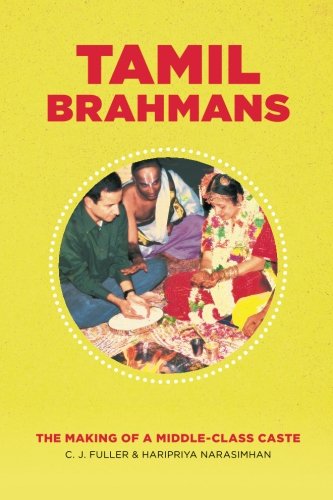
Tamil Brahmans: The Making of a Middle-Class Caste, by C. J. Fuller, Haripriya Narasimhan

Get Free Ebook Tamil Brahmans: The Making of a Middle-Class Caste, by C. J. Fuller, Haripriya Narasimhan
Tamil Brahmans: The Making Of A Middle-Class Caste, By C. J. Fuller, Haripriya Narasimhan. Accompany us to be member right here. This is the internet site that will certainly provide you ease of browsing book Tamil Brahmans: The Making Of A Middle-Class Caste, By C. J. Fuller, Haripriya Narasimhan to review. This is not as the various other website; the books will remain in the kinds of soft file. What benefits of you to be participant of this site? Obtain hundred collections of book link to download and install and also get constantly updated book daily. As one of the books we will offer to you now is the Tamil Brahmans: The Making Of A Middle-Class Caste, By C. J. Fuller, Haripriya Narasimhan that includes an extremely pleased idea.
If you get the printed book Tamil Brahmans: The Making Of A Middle-Class Caste, By C. J. Fuller, Haripriya Narasimhan in online book store, you may additionally locate the same issue. So, you have to relocate shop to shop Tamil Brahmans: The Making Of A Middle-Class Caste, By C. J. Fuller, Haripriya Narasimhan and hunt for the readily available there. Yet, it will certainly not occur below. The book Tamil Brahmans: The Making Of A Middle-Class Caste, By C. J. Fuller, Haripriya Narasimhan that we will provide here is the soft documents concept. This is exactly what make you could conveniently find as well as get this Tamil Brahmans: The Making Of A Middle-Class Caste, By C. J. Fuller, Haripriya Narasimhan by reading this website. Our company offer you Tamil Brahmans: The Making Of A Middle-Class Caste, By C. J. Fuller, Haripriya Narasimhan the most effective item, always and also always.
Never question with our offer, because we will always offer what you need. As like this updated book Tamil Brahmans: The Making Of A Middle-Class Caste, By C. J. Fuller, Haripriya Narasimhan, you may not discover in the other place. But right here, it's very simple. Simply click and also download, you can have the Tamil Brahmans: The Making Of A Middle-Class Caste, By C. J. Fuller, Haripriya Narasimhan When simpleness will reduce your life, why should take the challenging one? You could buy the soft documents of guide Tamil Brahmans: The Making Of A Middle-Class Caste, By C. J. Fuller, Haripriya Narasimhan right here as well as be member people. Besides this book Tamil Brahmans: The Making Of A Middle-Class Caste, By C. J. Fuller, Haripriya Narasimhan, you can likewise locate hundreds lists of the books from several resources, compilations, authors, and also authors in worldwide.
By clicking the web link that we offer, you could take guide Tamil Brahmans: The Making Of A Middle-Class Caste, By C. J. Fuller, Haripriya Narasimhan completely. Connect to net, download, and conserve to your gadget. Just what else to ask? Reviewing can be so simple when you have the soft documents of this Tamil Brahmans: The Making Of A Middle-Class Caste, By C. J. Fuller, Haripriya Narasimhan in your device. You could also duplicate the file Tamil Brahmans: The Making Of A Middle-Class Caste, By C. J. Fuller, Haripriya Narasimhan to your office computer system or in the house or even in your laptop computer. Simply discuss this good news to others. Recommend them to visit this page and obtain their searched for books Tamil Brahmans: The Making Of A Middle-Class Caste, By C. J. Fuller, Haripriya Narasimhan.
A cruise along the streets of Chennai—or Silicon Valley—filled with professional young Indian men and women, reveals the new face of India. In the twenty-first century, Indians have acquired a new kind of global visibility, one of rapid economic advancement and, in the information technology industry, spectacular prowess. In this book, C. J. Fuller and Haripriya Narasimhan examine one particularly striking group who have taken part in this development: Tamil Brahmans—a formerly traditional, rural, high-caste elite who have transformed themselves into a new middle-class caste in India, the United States, and elsewhere.
Fuller and Narasimhan offer one of the most comprehensive looks at Tamil Brahmans around the world to date. They examine Brahman migration from rural to urban areas, more recent transnational migration, and how the Brahman way of life has translated to both Indian cities and American suburbs. They look at modern education and the new employment opportunities afforded by engineering and IT. They examine how Sanskritic Hinduism and traditional music and dance have shaped Tamil Brahmans’ particular middle-class sensibilities and how middle-class status is related to the changing position of women. Above all, they explore the complex relationship between class and caste systems and the ways in which hierarchy has persisted in modernized India.
- Sales Rank: #445541 in Books
- Published on: 2014-10-03
- Released on: 2014-10-03
- Original language: English
- Number of items: 1
- Dimensions: 9.00" h x .80" w x 6.00" l, .0 pounds
- Binding: Paperback
- 288 pages
Review
“An essential read for all those who wish to understand how the concepts of both class and caste have changed. And for the community itself, an ‘unusual social group’, as Fuller and Narasimhan refer to them, this book will help them learn and reflect upon their achievements, gain a wider perspective of their history, and smile knowingly at the descriptions of their present lives.” (Radhika Santhanam The Hindu)
“Tamil Brahmans is a solid, original work that makes a major contribution to our understanding of a vitally important part of the world and of a unique group of people whose numbers in the United States are growing year by year and who are becoming increasingly influential at the highest professional levels in medicine, law, academia, business, and government.” (Sylvia J. Vatuk, University of Illinois at Chicago)
“For decades to come, if someone wants to understand the history and sociology of how and with what social effects the Tamil Brahmans have transformed themselves into a middle-class caste, they will read this book. Quite simply there is nothing comparable. Through comparisons with other Brahman communities throughout India, the authors show that the community-wide uniformity of Tamil Brahman achievement makes them truly unique.” (Mattison Mines, University of California, Santa Barbara)
“Drawing on interviews, historical statistics, and active engagement with former studies of Brahmans and other privileged communities in South India, C. J. Fuller and Haripriya Narasimhan have written an impressive biography of one of India's high-status communities over the past 150-odd years. . . . Tamil Brahmans will be a standard reference in the scholarship of Tamil Nadu and the conundrum of caste and class in general for many years to come.” (American Anthropologist)
“This historical analysis of ‘TamBrams,’ written by a unique combination of sociologists, both insider and outsider, provides essential fleshing out of our sociological understanding of caste and class, which has tended to concentrate on the lower end of the caste spectrum. It shows how it is not merely the lower castes who invoke their ‘caste identity’ in contrast to the castelessness and ‘merit’ of the middle classes, but that caste has been critical to the formation and professional success of an urban, ‘modern’ middle class like the Tamil Brahmans. This book is an indispensible read not just for all those who wish to understand caste formation, mobility, and change over the past two centuries, but also for Tamil Brahmans themselves. It will help them rethink the notion that their professional achievements are somehow exceptional and biologically rooted in their caste and see them instead as a product of the opportunities provided by the colonial and postcolonial state.” (Nandini Sundar, Delhi University)
About the Author
C. J. Fuller is emeritus professor of anthropology at the London School of Economics. He is the author of several books, including The Camphor Flame and The Renewal of the Priesthood. Haripriya Narasimhan is assistant professor of social anthropology and sociology at the Indian Institute of Technology Hyderabad.
Most helpful customer reviews
1 of 1 people found the following review helpful.
Inadequate Study
By V Lakshminarayanan
This is well researched book that a contains lot of information on Tamil brahmans. It covers the history of the social transformation of the community over the last century and a half. The authors’ efforts are to be appreciated for compiling so much information for today’s students of social studies. However their analyses and conclusions often missed the target.
The social scientists and works cited in the book are mostly Western, either European or American. As such it may not appear to present a problem but they are outsiders to the tradition. Outsiders can only write about the visible markers on the ground but cannot gain the insight of underlying causes or comprehend the soul of an alien society. It is the understanding of the soul of the community that will help to understand how it will further transform in the future. One of the authors is indeed an insider but her approach to the study is Western, and I think that she missed the target of understanding the soul of the community.
Indian social divisions are more complex that can be explained by one word “caste” as done by the authors and most Western social scientists. The division is composed of jati, varna, gotra, kula and more. Very few explicitly recognize that varna is an abstract, fluid and controversial hierarchical concept while jati is a reality for everyone because he/she is classified into a jati which is recorded in birth certificates, school and college records and other documents. Unfortunately the authors stuck to one word “caste” and failed to enlighten the readers of the distinction.
There is a comment that M. N. Srinivas’ work was somehow tainted because of his own brahman background (p 24). Nobody’s mind, including that of a Western scholar, is a blank slate when beginning to study Indian society. Every child in the West is taught in schools that Hinduism and Indian society being backward, superstitious, irrational, polytheistic, etc. It is naive to expect that the Western scholar erases such accumulated biases when undertaking the study of Indian society. Further, such diminishing of Srinivas’s work because of his origins amounts to cultural imperialism as it denies the agency to Indians to define who they are.
Authors acknowledge that the colonial rule consolidated the “caste system” (p 31, 56) but failed to elaborate on it. The purpose of the census exercise by the colonial government was to classify and rank the population on a civilizational scale under the racial theories and the ideas of Social Darwinism prevalent in Europe in the nineteenth century. The exercise reinforced the idea of jati identity among the indigenous population and in the process gave renewed life to the varna hierarchical ranking and thereby divided the society. The division added to the sense of security to the colonial authority which had experienced the nightmare of the rebellion of 1857.
Living in segregated areas of town (agraharam) is not unique to Brahman community. Most villages and small towns in Tamilnadu had segregated housing by jati groups among the non-brahmans as well, the degree of segregation dependent on the economic status of the groups. How much of this segregation was under the approval and encouragement of the authority is unknown and it needs to be studied further. Unfortunately the authors overlooked this and thereby implied that the segregated living was a unique brahman practice.
“the colonial government’s bureaucratic and legal system, which in theory, though not in practice, were organized by new principles of rationality and equity” (p217). Rationality is in the judgment of the observer but the equity can be measured. The strength of the colonial government depended on the division of the society and not equity. Any sense of equity among the ruled was perceived as a threat. The exercise of census was to reinforce and codify the division in ranks and categories. The colonial government early on had categorized brahmans as the “brown English men”, an idea floated by Macaulay, and ranked them at the top of the varna ranking ladder and facilitated their English education earlier than the other jatis. It explains their large presence in the government bureaucracy in the nineteenth century. This did not happen by accident but by design of the colonial government. The authors missed this in their scholarship and the reader is left with an incomplete history.
The book documents the social transformation over time but missed to focus on many forces that drove the transformation.
0 of 0 people found the following review helpful.
I would have preferred a tighter editing and a slimmer book but overall a good eye opening read
By Hari
Very interesting research on the early urbanisation of the tamil brahmins and how that has played out over the last 150 years, including their migration to other cities in India and outside. I would have preferred a tighter editing and a slimmer book but overall a good eye opening read.
0 of 0 people found the following review helpful.
A miniscule community punching above its weight.
By Amazon Customer
a well researched work and gives a reasonably accurate picture of a community which is spreading all over the world due pressures in the home country.a good example of how adversity makes you adventurous.
Tamil Brahmans: The Making of a Middle-Class Caste, by C. J. Fuller, Haripriya Narasimhan PDF
Tamil Brahmans: The Making of a Middle-Class Caste, by C. J. Fuller, Haripriya Narasimhan EPub
Tamil Brahmans: The Making of a Middle-Class Caste, by C. J. Fuller, Haripriya Narasimhan Doc
Tamil Brahmans: The Making of a Middle-Class Caste, by C. J. Fuller, Haripriya Narasimhan iBooks
Tamil Brahmans: The Making of a Middle-Class Caste, by C. J. Fuller, Haripriya Narasimhan rtf
Tamil Brahmans: The Making of a Middle-Class Caste, by C. J. Fuller, Haripriya Narasimhan Mobipocket
Tamil Brahmans: The Making of a Middle-Class Caste, by C. J. Fuller, Haripriya Narasimhan Kindle

Tidak ada komentar:
Posting Komentar